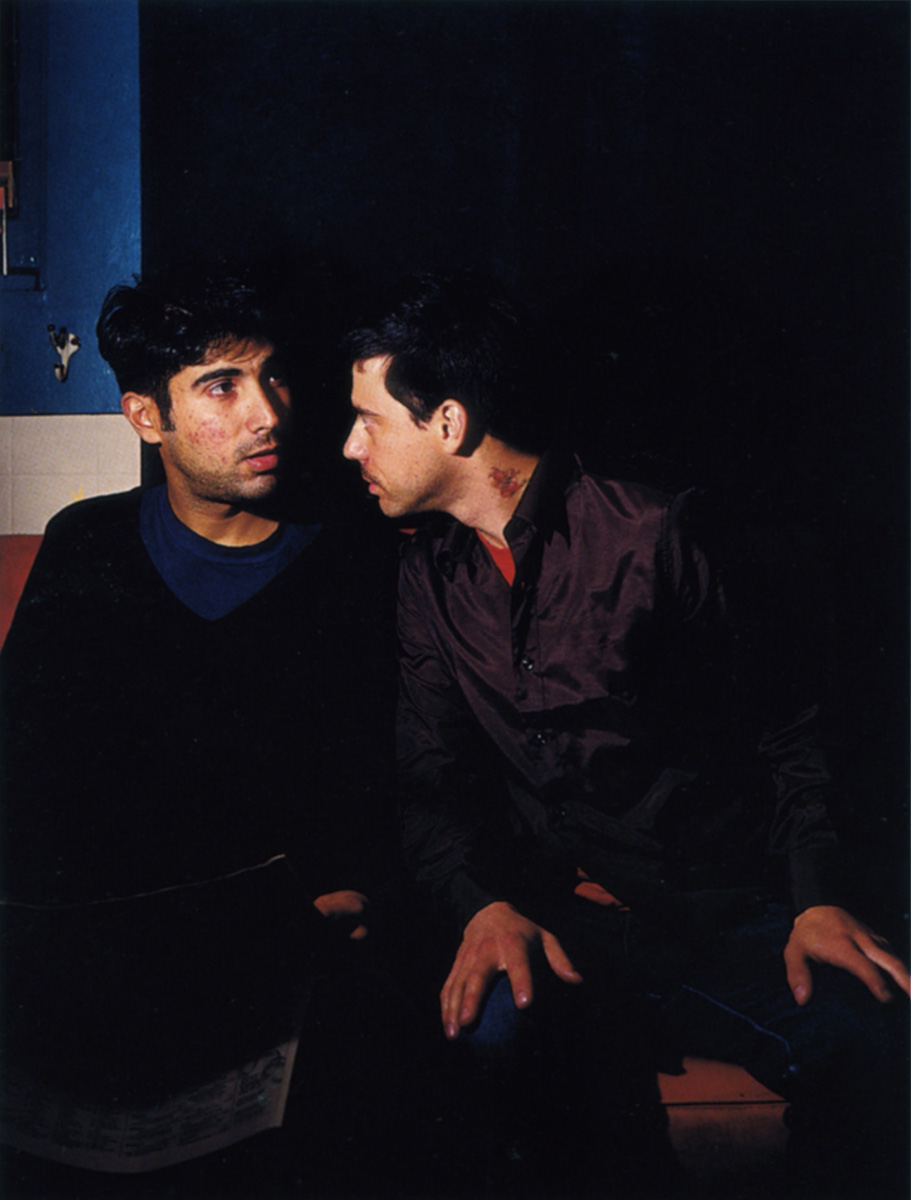
 Invasion of Personal Space I(The Sick Soul II), 1996
Breaking Down the Boundaries between Art and Life
Presentation at the Hochschule für Angewandte Kunst, Vienna 1995
The Genesis: From Open Libraries to Sociological Research
MARTIN GUTTMANN: We want to present a discourse around a piece of work that was shown in Cologne and with slight variations in Lüneburg. This piece of work developed out of an earlier project we did, the Open Libraries. When we first started developing those libraries in Hamburg we had a conversation in a seminar of Ulf Wuggenig at the Lüneburg University. We tried to explain how we thought about the concept of the Open Library and talked about it in terms of a theory of democratizing institutions. After a while we realized that from Ulf's point of view this seemed to be somehow strange or at least this was not the way he thought about it. We were referred to a body of material by sociologists from the late fifties who tried to research the very basic parameters about everyday behavior. We read some of those articles and found them quite fascinating. They were actually scientists who were asking very basic questions about in how far everyday behavior is rule-governed and who were trying to identify some of the most basic aspects. One of those scientists, Harold Garfinkel* for example did experiments like the following: He asked his students to go home, not to speak to their family and to see what kind of behavior would be provoked. The father would come home, sit on the table, and when his wife asked: "How are you?" he wouldn't say anything. And if the children asked: "What is wrong with you?" he again wouldn't say anything, and so on. Garfinkel tried to find out what kind of behavior one can expect when the most basic rules are broken. Other experiments that were mentioned in this article were for example the research on the concept of personal space: A person was sitting on a bench in the park. Somebody came and stuck his head very close to the others face. Again Garfinkel recorded the behavior of that person and how long it would take before she moved to another bench. The same experiments were done in libraries.
Together with that particular article we discovered a whole body of other articles, more or less at the same time as we were having this similar aspiration to investigate the basic parameters of everyday life. We started to discover that the motivation of those sociologists was to open up the field of sociology, for the sociology of the past has been oriented too much towards hermetic theory. The new sociologists tried to question basic presuppositions and to get data from the most elementary aspects of everyday life. We started discovering other articles in that area, for example the Garbage Project*, a very big project that actually cost several million Dollars. Sociologists researched the content of people's garbage for approximately one year, trying to make various analyses by correlating the type of garbage with the area, the type of people etc.
Another example: There was a guy, who was researching things like - it seemed fairly absurd - how long it takes people to urinate in public toilets in connection with how close the next person was standing to them. In order to do that - there was a little methodological part in this article - the researcher was hiding in the toilet with a stop watch and measured the time between the first time the zipper was opened till the moment when some liquid hit the urinal.
Then we rediscovered some even more famous articles like for example the Milgram* experiments that were done a little bit later. Some of you may know this fairly famous experiment: Test persons were asked to participate in a psychological research about learning. They were sitting in semi-transparent booths, so that they could see what was happening inside, but the people inside the booth couldn't see them. The idea was, that the test persons should punish the people inside the booth with an electric shock if they did not fulfill the test properly. They had a handle with electricity and were told that if they punished the people inside the booth severe damage was going to be caused. The people inside the booth were actors and the idea was to find out how far the test persons would punish the people inside the booth. It turned out that about 30 percent of the observing people actually would have killed the people who had learning problems. They punished them very severely.
Parallel Developments: Sociology, Candid Camera, and Popular Entertainment
As we were reading those articles it became very obvious that there was something there that wasn't quite mentioned, a lot of voyeurism and sadism. So we started thinking about those experiments in relation to Candid Camera shows and began to research the beginning of Candid Camera that took place exactly at the same time. The first thing we found quite interesting was that there are two cultural products appearing at the same time with some similarity in their basic approach. The early Candid Camera episodes were really oriented towards experimentation in the urban field. They were not so much oriented towards soft porno as they became in the seventies, but more oriented towards everyday situations.
There the voyeurism and sadism was a lot more accentuated. However, there was a genuine interest in trying to find out data about the behavior of people in particular situations. In fact some of the early Candid Camera episodes were actually structured more or less like an experiment. They would bring many people into the same situation and the film crew would just record one reaction after another, so that some kind of generalization became possible.
This became quite interesting and we started formulating the hypothesis that there were two parallel currents in culture, one in sociology and the other one in popular entertainment, both with very obvious parallel themes. We started reflecting on this phenomenon, how the same sensibility could be transformed into two cultural forms and what this exactly means.
Early Pop Art and Direct Contact with Everyday Life
Then we realized that precisely at this time the period of early Pop art had begun.
Cage, Cunningham, Rauschenberg and Jones spoke very much in the same terms. Rauschenberg talked about the fact that the way he made his painting was to take a walk around the block where his studio was, every day. He would take stuff that he found on the street, come back to the studio and make a painting. Again the idea seemed to be that one should try to get the material for art directly from everyday life, without recourse to too much transformation. One wanted to revive the medium to more or less direct contact with everyday life. Cage was quite clear about this point. He spoke about every type of noise as music, and again the idea was that one should not think of music in terms of specialized sets of sounds but that any type of sounds can make music. The emphasis again was on directness, lack of any transformation of strategy and a kind of openness. So this became another clue for us.
It became interesting to situate the discourse of art between the two developments, namely between popular entertainment on the one hand and sociology on the other hand. Within these three forms we began to think about how to articulate those three parallel lines.
Wittgenstein, Situationists, and Breaking Down Cultural Boundaries
One can really continue and talk about other developments with very similar ideas and motivations. For example, in philosophy in the early fifties again there was a fascinating development that started with Wittgenstein's philosophical investigations*. He repudiated his earlier writings as being too closed, too idealized as an analysis of language. His new method was to look at concrete examples from the English language, directly analyze phrases that people actually use and to derive the philosophical categories in the philosophical grammar directly from observing how people spoke.
One can go further now and look at other developments at the same time: The situationists in the mid and late fifties had another fairly parallel discourse. People took a lot of ideas from the surrealistic development but tried to transform them into a very direct action that is taking place in the urban field. They were actually taking walks rather than sit at home and fantasize like Breton. They were outside in the urban field trying to intervene and to take the clues directly from the flow of people in the cities. Finally, having observed all the parallel developments, we started thinking in more general terms. On a more abstract level we realized that it was quite difficult to find a point of view that could develop themes like parallelism in culture, because most of the discourses in art, sociology, philosophy and so on always tried to establish a very hermetic field with its own methodology, its own terminology and so on. So we ended up discovering here a new theme that we would call: Breaking Down the Boundaries between Art and Life.
We are going to show you right now work that is also about breaking down those boundaries. The difference to earlier work that we did is that there we were very much interested in working with material that clearly seems to indicate that it has a social relevance. The libraries are a good example in that sense. Libraries are a very clear, public medium. When you are involved in the construction of a library, you are by necessity dealing with institutions, politics and society. You can have your own interpretation of what it means, what your own political agenda is and so on, but it was very clear to everybody that you are dealing with a social medium.
This work here is going in a different direction. What we were trying to do here is to indicate that even in the most hermetic type of work, like experimental research to the behavior of people in particular types of situations, you are still in a sense dealing with political material. At the same time, on the level of the experiment itself, one can bring it so close to the real situation, that eventually the experiment turns into a real social action where the experimentation is not just experiment anymore but already a social act. So this actually is the other way around: you can enter the social dimension by being as hermetic and as experimental as you want. You don't necessarily need to do something that has a very obvious political or social relevance.
Presenting the Work: Open Libraries and the ATM Video Installation
Let us show you the slides:
This is the Open Library in Lüneburg. It was a city-wide project during a city festival in the summer. It was 24 libraries that were placed into the city. This is Graz. It's the Library of the Steirischer Herbst that we did with the festival last year. Grazer Kunstverein, we placed a library there. This is Hamburg. This is where we actually started the discourse I was talking about.
Here you see the location in front of the Lüneburg University where we placed one of those libraries. Actually I wanted to show you another image but we couldn't find it, which is very strange. But I will try to explain later the story with this library that will give you an indication what I mean by the idea that the library itself can produce evidence.
Here you see the library of Luneburg in detail. You see that there is a transparent structure. There are two walls that are made out of transparent material so that the books are visible. You can take a book out, you can bring a book back. The idea was that there were books that were placed in, but if somebody wanted to take a book from his home and bring it to the library, he could do that. Also you could read on the streets. You could also take the book home and never bring it back.
This is the exhibition, a video installation that we made for the Kunstverein in Cologne and it was also shown in Lüneburg University during a symposium.
Here you see a monitor. There's about 12 monitors in the gallery space in Cologne. Each monitor shows an edited version of real documentary material that we shot on the streets of Cologne. We will explain in detail in a minute what this material is and how the editing works. I will just try to give you an overview about the installation itself. The idea was that we just put those monitors into the exhibition space with no further explication, no wall text whatsoever about the work. The only thing you could get was a pamphlet in which you could read the whole discourse about the parallel developments of sociology, popular entertainment and so on as I indicated before.
People would come into the gallery space and they would see those monitors and they would try to understand: "What is this? What is going on here?" They would just see people in very particular behavior on the streets. Okay, so here it starts to get interesting.
The ATM Experiment: Filming Human-Machine Interaction
This is now the material that we showed in those monitors. This is shot in real time. We stationed ourselves in the city of Cologne in front of an ATM machine with a video camera. We were hiding behind the window so that people wouldn't see us and we filmed people while they were getting money. The camera was zooming in on their face at the moment when they were putting in their code. We wanted to test if people's face changed when they were putting in their code, whether they became somehow more nervous, more concentrated or whether there was absolutely no change.
It turned out that the effect was zero. There was absolutely no change in behavior. People don't get nervous when putting in their code. But once we did about 100 people we started analyzing the material for an editing. Precisely at this moment it became obvious that something much more interesting was happening.
We started realizing that the way people look when they put money into a machine is slightly different from how they look when talking to you. Not in any particular way that you can specify in words, it's just a certain look, a certain quality. You start recognizing a human being vis-à-vis a machine and you can maybe start working with the hypothesis that people are not being watched, they are not thinking that there is a social communication involved, and this in fact creates a different expression. We became interested in collecting the material that proved this hypothesis.
So what we did: We took out a segment where people were putting in the code which were about 2 to 3 seconds long. We edited them into a loop. We did about 100 people. Some of those loops were 2 seconds, some 4 seconds and so on. And then we programmed the video so that the loops were shown in a random order. This means that you were looking at the monitor and after 2 seconds a new person would appear, then 4 seconds, somebody else, and so on. Since people do not know that this is a loop, they see the person appearing, they recognize that there is a certain type of stare in the face. They wait to see what is going to happen next. But what happens next is that the person appears again and again and stares in exactly the same way. People start wondering: "Is this person mentally retarded or what's the problem with this person?" It gives them a fairly uncanny experience. Usually people in front of those monitors after a minute or two start having the urge to look for some explanation. They go around the exhibition space and see if there are wall labels. And since they don't find wall labels they usually will get the pamphlet.
At that point they will read the discourse and they will be referred back to the Milgram experiments. They will read about Candid Camera and they will read about all the other experiments that were done. They will also read a very extensive account about various theories of experimental practice, how is it possible that one can make experiments and what is the political meaning of experimental practice. So they will have something to read for about 20 to 30 minutes. And then they come back to the images and they try to reevaluate the images from another point of view. Now they know it's an experiment. Now they start realizing that there must be people in the real city. They see that those are just like everyday people and they will ask themselves questions: "Were those people told? Did they give permission? What was the extent of the control? What are we doing here in the gallery watching those people?"
Since the discourse in the pamphlet refers very directly to the tradition of Milgram, Garfinkel and so on, they recognize very quickly the connection to the tradition that always had this very thin line between legitimate experimentation and voyeurism and even sadism. They start recognizing something like a gray zone that is opened up by the experiment. And they become very quickly also very uncomfortable because they recognize that they are also sitting there and watching those people. In other words they don't have any control, they cannot distance themselves in that sense. They are implicated in the sadism and voyeurism themselves.
In Cologne we had fairly interesting reactions to the work. About every second person or something like that in the exhibition space had fairly clear moral objections about what we were doing. They thought that what we are doing is highly immoral, highly objectionable, highly questionable and so on. We wanted to open up this gray zone and we wanted to see what kind of reaction people have to it. We deliberately didn't tell people in the city. There was no contract. People were not told that they were filmed. We were just watching them and recording them. In Germany there is a law that forbids filming in public without permission. We knew about that and we decided to do it anyway.
Ethics vs. Legality: The Gray Zone of Research
Okay, this brings me to the next theme, the discourse about the relationship between the legality and the ethics of an action. I want to go into this in detail because I think this is very crucial for understanding the work. Let me just sketch a very simple argument: There are obviously codes in any society that define what is legitimate, what is legal and what is not legal. But those legal structures are actually not in any simple way the same thing as ethics. Ethics is a much more general question about what is good and what is bad. And very often the legal structure is actually in conflict with what one would consider ethical behavior.
Let me give you an historical example: When the Nazis came to power in Germany in 1933, one of the things they did was they started forbidding people to employ Jews. Now according to the law at that time in Germany this was perfectly legal. If you employed a Jew after a certain date you would actually break the law. However, if you think about ethics, if you believe that human beings should be treated in an egalitarian way, then you would say that the ethical thing to do is to break the law and to continue to employ Jewish people. So you see: there is a fundamental conflict between legality and ethics.
Now we can go forward in history and we can ask ourselves: Are there current laws that are equally problematic? I think there are many laws that are questionable. For example the law in Germany about filming in public: We think that there are good arguments why this law exists, namely it protects people's privacy. But we also think there are good arguments why in particular cases it would be justifiable to break this law. For example if you are doing research, if you are trying to collect material about how people behave in public and if the material is used in an ethical way, meaning that you are not trying to damage those people, you are not trying to use the material against them or harm them, then we think it's actually justifiable to break the law. We think the law is too restrictive in that sense.
Now the question is: Can art be one of those areas where it would be legitimate to break this particular law? We think yes. We think that if art has a research dimension, if it's trying to understand something about the social reality and if the material is used in a way that is not harmful to people, then it should be possible for art to break this law. However we also think that we cannot take this decision by ourselves. In other words we cannot decide: "Okay, we break the law and that's fine." We think that this decision has to be made by the public sphere, by the people who are looking at the work, by critics, by curators, by other artists and so on.
That's exactly what we wanted to provoke with this installation. We wanted people to confront this question: Is it okay what we are doing here or is it not okay? And we wanted to see what kind of reactions we get. We deliberately made the work in such a way that it's very difficult to have a clear answer. Some people said: "This is completely unethical, you shouldn't be allowed to do this." Other people said: "No, this is actually very important research and it's okay that you did it." We wanted to create this ambiguity because we think this is where interesting things happen.
MARTIN GUTTMANN: Now we can continue. Michael will present another aspect of the discourse around the work.
Intention and Reception: The Gap Between Artist and Audience
MICHAEL CLEGG: One of the things we wanted to raise with this work is the question: What is the relationship between the intention of the artist and the reception of the work? This is a classical question in aesthetics but we wanted to give it a particular spin.
Usually when we think about art we think that the artist has a certain intention, creates a work and then the public receives the work and interprets it. There's always a gap between what the artist intended and what the public understands. This is completely normal and everybody accepts this. However, we wanted to radicalize this gap. We wanted to create a situation where the gap between intention and reception becomes so large that it actually creates a new quality.
How did we do this? Well, first of all we created a work where people don't know initially what they're looking at. They see these images on the monitors but they don't understand what's going on. They have to read the pamphlet to understand the context. So there's already a temporal gap: first you see the images, then you read about them, then you come back to the images. This temporal structure already creates a certain ambiguity.
But more importantly, we created a situation where our intention is actually impossible to determine from the work itself. If you just look at the images on the monitors, you could think: "Maybe these artists are just voyeurs. Maybe they just enjoy watching people." You don't know. You need the pamphlet to understand that we're actually trying to create a discourse about experimentation, about the ethics of research, about the boundaries between art and life and so on. But even after you read the pamphlet, you still don't know: Are we really serious about this discourse or are we just using it as an excuse to do voyeuristic work?
We deliberately created this ambiguity because we think it's very productive. It forces people to take a position. They cannot just passively consume the work. They have to decide: Do I believe these artists are serious? Do I think what they're doing is justified? Or do I think they're just being cynical?
This brings me to another point which is very important for understanding our work: We don't believe that the meaning of a work of art is determined by the artist's intention. We think that the meaning of a work emerges in the social process of reception, interpretation, discussion and so on. The artist can initiate this process but cannot control it.
This is very different from how most artists think about their work. Most artists believe that they know what their work means and they want the public to understand it correctly. We don't think like this. We think that our work is successful if it generates interesting discussions, if it provokes people to think, if it creates controversy and so on. We don't care if people "misunderstand" our work because we don't think there's a correct understanding.
MARTIN GUTTMANN: Let me add something to what Michael just said. This relates to a very fundamental question about the nature of political art. There's a long tradition in the left, especially in Germany, of thinking that political art should have a very clear message. The idea is: the artist has a political position, creates a work that expresses this position, and the public receives the message and is convinced by it. This is a very instrumental understanding of political art.
We completely reject this model. We think it's naive and actually counterproductive. Why? Because in reality people are not convinced by being told what to think. If you create a work that says "capitalism is bad" or "racism is bad" or whatever, people who already agree with you will like it and people who don't agree with you will ignore it or reject it. You're not changing anything.
We think political art should work differently. It should create situations where people are forced to think for themselves, where they cannot rely on pre-existing opinions, where they have to make difficult decisions. This is what we tried to do with this work. We created a situation where people cannot easily say "this is good" or "this is bad." They have to think about it. They have to ask themselves: What do I think about the ethics of experimentation? What do I think about the relationship between legality and ethics? What do I think about the role of art in society?
This is a much more radical form of political art because it actually challenges people's thinking process itself. It doesn't just tell them what to think but makes them think differently.
AUDIENCE MEMBER: But don't you think there's a danger that people will just say "this is unethical" and walk away without engaging with the deeper questions?
MARTIN GUTTMANN: Yes, absolutely. Many people did exactly that. But we think that's also interesting. It shows something about how people think about ethics. It shows that many people have a very rigid, rule-based understanding of ethics where they just apply a simple rule: "filming people without permission is bad" and that's it. They don't think about the context, they don't think about the purpose, they don't think about the consequences. They just apply the rule.
We think this is a problem. We think ethics should be more contextual, more situational. And by creating a work where people's rule-based ethics doesn't give them a clear answer, we're challenging them to think more deeply.
AUDIENCE MEMBER: But didn't some people actually feel violated? The people who were filmed without their knowledge?
MICHAEL CLEGG: That's a good question. Actually we don't know because we never contacted them. We deliberately didn't contact them because that would have changed the nature of the experiment. If we had told them afterwards "hey, by the way, we filmed you and showed you in an art exhibition," that would have created a completely different situation.
But you're right to ask about this because it points to a real ethical problem. And we don't have a simple answer. We can say that we tried to be careful. We didn't show people in embarrassing situations. We just showed them putting in their code at an ATM machine, which is a completely normal, everyday action. We didn't use the material to harm them in any way. But still, you could argue that we violated their privacy.
This is exactly the gray zone we wanted to explore. We think this gray zone is very important because it's where real ethical thinking has to happen. It's easy to say "never film people without permission." It's much harder to think about the specific context and ask: In this particular case, with this particular purpose, with this particular usage of the material, is it ethical or not?
MARTIN GUTTMANN: Let me add something. You have to understand that we're not saying "anything goes." We're not saying that any violation of privacy is okay as long as it's done for art. We're saying something much more specific: We think that in certain contexts, for certain purposes, it can be justifiable to break certain rules. But this justification has to be argued for, it has to be defended in public, it has to be discussed. That's exactly what we're doing here. We're not just breaking the rule and saying "trust us, we're artists." We're breaking the rule and then exposing ourselves to public criticism and discussion.
AUDIENCE MEMBER: But you're exposing yourselves after the fact. The people who were filmed didn't have a choice.
MARTIN GUTTMANN: That's true. But that's also the nature of many social experiments. If you tell people in advance what you're doing, you change their behavior. That's exactly what Garfinkel discovered. If he had told the father "we're doing an experiment where you don't talk to your family," it wouldn't have been an experiment anymore. The whole point is to observe natural behavior.
Now you could say: social experiments should be forbidden. And maybe you're right. But then you have to accept the consequences: we lose the ability to do certain types of research about human behavior. We lose the ability to gain certain types of knowledge about society.
We think this would be a loss. We think experimental research, including controversial experimental research, has value. But we also think this value has to be constantly questioned and discussed. That's what we're trying to do with this work.
Critical Debate: Political Art and Bourgeois Ideology
LUKAS PUSCH: I have a fundamental problem with your approach. You're presenting yourselves as if you're doing radical, political work. You're talking about breaking boundaries, about challenging ethics, about creating controversy. But actually what you're doing is just reproducing the most traditional role of the artist: the artist as provocateur, the artist as someone who stands outside society and criticizes it.
This is not radical at all. This is the most bourgeois understanding of art possible. The real radical question would be: How can we actually change society? How can we actually create new forms of social organization? Not: How can we create controversial art exhibitions?
MARTIN GUTTMANN: I think you're confusing two different things. On the one hand there's the question: What is the role of art in society? On the other hand there's the question: What is the role of political action in society? We're not claiming that art can replace political action. We're not saying that making art exhibitions is the same thing as organizing workers or fighting for political change.
What we are saying is that art has its own specific role to play. And this role is related to thinking, to reflection, to questioning assumptions. Art cannot change society directly but it can change how people think about society. And changing how people think is also a form of political work.
LUKAS PUSCH: But that's exactly the problem. You're accepting the bourgeois separation between thinking and acting, between theory and practice. Real revolutionary politics means overcoming this separation. It means thinking through action, not thinking and then maybe acting or not acting.
MARTIN GUTTMANN: I don't think we're accepting this separation. Look at the Open Libraries project: that was very much about action. We didn't just think about libraries, we actually built them and placed them in public space. We created a real social intervention. And the same is true for the ATM work: we actually filmed people, we actually created a situation that had real social consequences.
The difference is that we don't think our actions are going to directly create revolutionary change. We think they're going to create a certain type of experience, a certain type of reflection, a certain type of discussion. And we think this has value.
LUKAS PUSCH: But this is exactly what I mean by bourgeois individualism. You're creating experiences for individual visitors to art exhibitions. You're not creating collective political action. You're not organizing people. You're not building movements. You're just making art for the art world.
MARTIN GUTTMANN: But we don't think the art world is hermetically sealed from the rest of society. People who come to art exhibitions are also people who vote, who work, who have families, who participate in society in many ways. If we can change how they think about ethics, about experimentation, about the boundaries between public and private, then this can have effects beyond the art world.
Also, you're assuming that the only valuable political action is mass action, collective action, revolutionary action. We don't think that's true. We think there are many different forms of political action at many different scales. And we think that even small-scale actions, even individual experiences, can have political significance.
LUKAS PUSCH: That's a very convenient position for artists. It means you never have to actually prove that your work has any political effect. You can always say "well, maybe it changed someone's thinking" even if there's no evidence of this.
MARTIN GUTTMANN: You're right that it's difficult to measure the political effects of art. But the same is true for many forms of political action. How do you measure the effects of a demonstration? How do you measure the effects of a political speech? How do you measure the effects of a political pamphlet? You can't measure these things precisely but that doesn't mean they have no effect.
MICHAEL CLEGG: I think we need to be more specific about what we mean by "political." There are different levels of political action. There's the level of organized politics: parties, unions, movements and so on. But there's also the level of everyday politics: how people interact with each other, how institutions function, how norms are established and challenged.
Our work is not operating at the level of organized politics. We're not trying to organize a political party or start a revolution. We're operating at the level of everyday politics. We're trying to understand how institutions work, how norms function, how people behave in specific situations. And we think this understanding is also politically valuable.
LUKAS PUSCH: But understanding is not enough. Marx said: philosophers have only interpreted the world, the point is to change it.
MARTIN GUTTMANN: Yes, but Marx also spent most of his life writing books. He didn't just go out and organize workers. He did both: he organized and he wrote theoretical works. And I would argue that his theoretical works have had a much bigger impact than his organizational activities.
We're not comparing ourselves to Marx, obviously. But we're making a similar point: theoretical work, analytical work, investigative work is also important. It's not the only thing that's important but it is important.
LUKAS PUSCH: But Marx's theoretical work was directly connected to the workers' movement. It wasn't just abstract analysis. It was analysis for the purpose of revolutionary change.
MARTIN GUTTMANN: And our work is also connected to social movements and social change. Maybe not in such a direct way as Marx's work but it's still connected. The Open Libraries project, for example, was very much about democratizing access to information, about creating public space, about challenging institutional hierarchies. These are all themes that are relevant to progressive social movements.
AUDIENCE MEMBER: Can I ask a practical question? What happened with the people who objected to the ATM work? Did anyone take legal action?
MICHAEL CLEGG: No, nobody took legal action. Some people complained to the gallery. Some people complained to us directly. But nobody actually sued us or reported us to the police.
I think this is interesting because it shows that even though people had moral objections, they didn't necessarily want to use legal mechanisms to stop us. Maybe because they understood that there's a difference between legal rules and ethical judgment. Maybe because they understood that the work was raising important questions even if they disagreed with our methods.
AUDIENCE MEMBER: Or maybe because they didn't want to deal with the hassle of a lawsuit.
MICHAEL CLEGG: That's also possible. But either way, the fact is that the work generated discussion and controversy without anyone actually using legal mechanisms to shut it down. And we think this is good. This is how public discourse should work: through argument and discussion, not through legal prohibition.
MARTIN GUTTMANN: Let me come back to Lukas's critique because I think there's something important we need to address. You're accusing us of bourgeois individualism. But I want to turn this around: I think your position is actually the one that's problematic.
You seem to have a very rigid idea of what counts as political action. It has to be collective, it has to be organized, it has to aim at revolutionary change. Anything else is dismissed as bourgeois individualism. But this position has a problem: it dismisses 99% of human activity as politically irrelevant. According to this logic, if you're not organizing a revolution, you're not doing anything political.
We think this is wrong. We think politics happens at many levels and in many forms. Yes, organized collective action is important. But so is everyday resistance. So is questioning norms. So is experimenting with new forms of social interaction. So is creating spaces for reflection and discussion.
Our work is trying to operate at these different levels. Sometimes we create collective projects like the Open Libraries. Sometimes we create more experimental, research-oriented work like the ATM piece. But in both cases we're trying to engage with political questions, just in different ways.
LUKAS PUSCH: I still don't see what's political about filming people without their consent and showing it in an art gallery. That's not politics, that's just voyeurism with a theoretical justification.
MARTIN GUTTMANN: But you're missing the point. The political dimension is not in the filming itself. The political dimension is in the discourse that the work generates. The work creates a situation where people have to think about questions like: What is privacy? What is the public sphere? What is legitimate research? What is the role of institutions? What is the relationship between individual rights and collective knowledge?
These are all political questions. And by creating a work that doesn't give simple answers to these questions, we're forcing people to think about them in a more complex way.
LUKAS PUSCH: But these questions are only political if they're connected to actual political struggles. If they're just abstract questions discussed in art galleries, they're not political, they're just philosophy.
MARTIN GUTTMANN: But they're not abstract. They're very concrete. The question of privacy is directly relevant to current political debates about surveillance, about data collection, about the power of corporations and governments. The question of legitimate research is directly relevant to debates about scientific ethics, about medical experiments, about the limits of investigative journalism. These are not abstract questions, they're questions that affect people's lives.
MICHAEL CLEGG: And I would add: the fact that these discussions are happening in art galleries doesn't make them apolitical. Art galleries are part of the public sphere. They're places where public discourse happens. Not the only places, obviously, but they are part of it.
LUKAS PUSCH: Art galleries are elite spaces. They're not accessible to most people. So even if important discussions are happening there, they're only happening among a small elite.
MARTIN GUTTMANN: That's partly true. But it's also changing. More and more people are visiting art exhibitions. More and more people are engaging with contemporary art. And also, the discussions that happen in art galleries don't stay in art galleries. They spread through publications, through media coverage, through word of mouth.
Also, we don't only work in art galleries. The Open Libraries were placed in public streets, in neighborhoods, in places where anyone could access them. So we're not just working within elite spaces.
LUKAS PUSCH: But the Open Libraries are still art projects. They're still framed as art. And this framing changes everything. It means they're not really libraries, they're representations of libraries. They're not really public institutions, they're art institutions.
MARTIN GUTTMANN: I disagree completely. The Open Libraries were real libraries. People could really take books. People could really donate books. They functioned as real public institutions. The fact that they were also art projects doesn't negate this reality.
This is exactly what we mean by breaking down the boundaries between art and life. We're not interested in creating representations of social institutions. We're interested in creating real social institutions that also function as art. The two things are not mutually exclusive.
MICHAEL CLEGG: This is a very important point. A lot of political art makes the mistake of thinking that it has to represent political reality rather than intervene in political reality. So you get art that shows images of poverty or oppression or whatever. But this doesn't change anything. It just represents what already exists.
We're trying to do something different. We're trying to create real interventions that actually change something, even if it's small. The Open Libraries actually changed the information infrastructure of the neighborhoods where they were placed. The ATM work actually changed people's thinking about privacy and experimentation. These are real effects, not just representations.
The Open Libraries: Real Institutions vs. Art Institutions
LUKAS PUSCH: But the effects are temporary. The libraries were taken down after a few months. The ATM work was shown in a gallery for a few weeks. Nothing permanent changed.
MARTIN GUTTMANN: But permanent change is very rare. Even successful political movements often have temporary effects that later get reversed. Does that mean they weren't valuable? I don't think so.
Also, some effects are invisible. They're changes in consciousness, changes in thinking, changes in possibility. These things don't disappear when the physical installation is taken down.
KURT KLADLER: Maybe I can intervene here. I think there's a fundamental disagreement about the relationship between critical practice and emancipatory practice. Lukas seems to be demanding emancipatory practice: practice that directly contributes to human liberation. Martin and Michael seem to be defending critical practice: practice that questions and analyzes without necessarily offering solutions.
These are two different models of political engagement and they can't be easily reconciled. But I don't think one is necessarily better than the other. They serve different functions.
MARTIN GUTTMANN: I think that's a fair characterization. We are definitely more interested in critical practice than in emancipatory practice, at least in the sense that we don't think our work is going to directly liberate anyone. But we do think that critical practice has political value. We think that questioning assumptions, exposing contradictions, creating spaces for discussion - these are all politically valuable activities.
LUKAS PUSCH: But critical practice without emancipatory goals just becomes endless criticism. It becomes a comfortable position where you can always criticize everything but never commit to anything.
MARTIN GUTTMANN: That's a risk, I agree. But I think there's an equal risk on the other side: emancipatory practice without critical reflection can become dogmatic. It can lead to the belief that you know exactly what liberation looks like and anyone who disagrees is an enemy.
We're trying to maintain a critical stance precisely because we don't think we know all the answers. We think political reality is complex and we need to keep questioning our own assumptions as much as we question others' assumptions.
MICHAEL CLEGG: And I would add that we do have political commitments. We're committed to democratization. We're committed to public access to information and culture. We're committed to questioning institutional hierarchies. These are not just abstract values, they guide our actual practice.
But we don't think these commitments should lead to dogmatism. We think they should lead to experimentation. We should try different approaches, see what works, learn from failures, adjust our methods. This is a pragmatic approach to politics, not an ideological approach.
LUKAS PUSCH: Pragmatism is just another word for reformism. It means accepting the basic structures of society and just trying to make small improvements.
MARTIN GUTTMANN: I don't think that's necessarily true. Pragmatism can also mean being realistic about what's possible while still working towards radical change. It means not wasting energy on symbolic actions that don't have real effects while still maintaining a vision of deep transformation.
Also, I think there's a false dichotomy here between reform and revolution. In reality, most significant social changes happen through a combination of reforms and more radical transformations. The idea that there's going to be one big revolution that changes everything is, I think, a fantasy.
AUDIENCE MEMBER: Can I bring this back to the specific work? I'm still not clear about what you learned from the ATM experiment. You said people's faces don't change when they put in their code. So what was the point?
Human-Machine Interaction and Surveillance Culture
MARTIN GUTTMANN: The point wasn't just to collect data about facial expressions. The point was to create a situation where we could observe the relationship between humans and machines, between public and private, between being watched and not being watched.
What we discovered - and this only became clear during the editing process - was that people do look different when they interact with machines compared to when they interact with humans. There's a certain quality to the gaze, a certain way of being, that's different. It's hard to describe in words but it's visible in the images.
And this discovery has implications. It suggests that our relationship with technology is changing how we present ourselves, how we perform our identity. When we interact with machines, we can afford to be less self-conscious, less performative. But this also means we're more vulnerable. We're revealing aspects of ourselves that we normally keep hidden.
MICHAEL CLEGG: And this connects to larger questions about surveillance, about digital technology, about the transformation of public space. We live in a society where we're constantly being recorded by machines: security cameras, smartphones, computer systems. But we don't really think about what this means for our behavior, for our sense of self, for our relationship to public space.
The ATM work was trying to make this visible. It was trying to show people something about their own behavior that they're normally not aware of. And by making it visible in an art context, we were creating a space for reflection and discussion.
AUDIENCE MEMBER: But couldn't you have done this without actually filming real people? Couldn't you have used actors or something?
MARTIN GUTTMANN: We could have, but then it wouldn't have been the same work. The whole point is that these are real people in real situations. If they were actors, the whole dynamic would change. It would become a representation rather than documentation. And we're specifically interested in the ethical and political questions that arise from documenting real behavior without consent.
AUDIENCE MEMBER: So the ethical controversy is actually part of the work?
MARTIN GUTTMANN: Exactly. The ethical controversy is not a side effect of the work, it's central to the work. We deliberately created a situation that would generate ethical discussion because we think these discussions are important. We think society needs to have these discussions about the limits of research, about privacy, about surveillance and so on.
LUKAS PUSCH: But that's just instrumentalizing people for your art project. You're using them without their consent to create controversy in the art world. That's deeply problematic.
MARTIN GUTTMANN: I understand your objection. But I would argue that journalism does the same thing all the time. Journalists film people in public without consent, use their images to make points about society, generate controversy and discussion. We don't usually object to this because we think journalism serves a public function.
The question is: Can art serve a similar public function? Can art also engage in this kind of investigative, documentary practice? We think yes. But we also think this requires public discussion and debate. That's exactly what we're having right now.
LUKAS PUSCH: But journalists have professional standards. They have codes of ethics. They're accountable to editors and publishers. Artists just do whatever they want and call it freedom of expression.
MARTIN GUTTMANN: That's not entirely fair. Artists also have professional standards, though they're different from journalistic standards. And artists are accountable to galleries, curators, critics, the art public. The difference is that artistic accountability is more diffuse, less institutionalized. But it's still real.
Also, I would question whether journalistic standards are always adequate. There are many cases where journalism violates privacy, causes harm, serves corporate or political interests. The existence of professional standards doesn't automatically make practice ethical.
MICHAEL CLEGG: I think we need to accept that there's an inevitable tension here. On the one hand, we have legitimate concerns about privacy and consent. On the other hand, we have legitimate needs for research, investigation, documentation. These two things are in conflict and there's no simple way to resolve the conflict.
What we're trying to do with our work is make this tension visible and productive. We're not claiming to have solved the problem. We're claiming to have created a situation where the problem can be discussed and thought about in a concrete way.
AUDIENCE MEMBER: Has anyone from the media written about this work?
MARTIN GUTTMANN: Yes, there were several reviews in art magazines and newspapers. The reactions were mixed. Some critics praised the work for raising important questions. Others criticized it for being voyeuristic or unethical. Which is exactly what we expected and wanted.
AUDIENCE MEMBER: Were you ever contacted by privacy advocates or civil liberties organizations?
MICHAEL CLEGG: No, we weren't. I think the work remained too much within the art world context to attract that kind of attention. If we had done it on a larger scale or in a more public way, maybe we would have gotten more attention from those organizations.
MARTIN GUTTMANN: And maybe that would have been interesting. Maybe we should do a version of the work that deliberately tries to engage with privacy advocacy groups, with ethicists, with legal scholars and so on. That could create an even more interesting public discussion.
LUKAS PUSCH: This just confirms what I was saying. You're operating within the art world. You're not really engaging with actual political institutions or movements. You're just creating controversy within a very limited context.
MARTIN GUTTMANN: But we have to start somewhere. We can't just immediately engage with the entire political system. We start with the contexts we have access to, which is the art world. And then we try to expand from there. The Open Libraries project was an attempt to do exactly that: to work in public space, to engage with local institutions, to create something that's accessible to people outside the art world.
AUDIENCE MEMBER: Can you talk more about the Open Libraries? How did they work in practice?
Artistic Research: Anecdotes, Documentation, and Social Knowledge
MICHAEL CLEGG: Sure. The basic concept was simple: we built wooden structures that looked like library shelves, filled them with books, and placed them in public spaces. People could take books without any registration or identification. They could also donate books if they wanted.
The interesting thing was that each library developed its own character depending on where it was placed and who used it. Some libraries became meeting points for the neighborhood. Some libraries were heavily used, others less so. Some libraries were vandalized, others were carefully maintained by local residents.
In Hamburg, for example, we placed a library in a working-class neighborhood with a high percentage of immigrants. We were nervous about whether it would be accepted or vandalized. It turned out that local residents took very good care of it. They organized themselves to make sure it was maintained. Some people even built a roof over it to protect it from rain.
This was fascinating to us because it showed that people were taking ownership of the library. It wasn't just an art installation anymore. It had become a real community resource.
MARTIN GUTTMANN: And this is where the research dimension comes in. By observing how different communities interact with the libraries, we learn something about those communities. We learn about their relationship to public space, to cultural institutions, to collective resources. This is social research through artistic practice.
LUKAS PUSCH: But you didn't do any systematic analysis of this data. You didn't publish any research findings. So how is this research?
MARTIN GUTTMANN: It's a different kind of research. It's not social science research with statistical analysis and peer review. It's artistic research where the findings are communicated through the work itself, through documentation, through discussion.
Also, we did document the project extensively. We took photographs, we conducted interviews, we kept records of what happened. This documentation is part of the work.
LUKAS PUSCH: But documentation is not the same as analysis. Without analysis, you just have anecdotes, not knowledge.
MARTIN GUTTMANN: I disagree. I think anecdotes can be a form of knowledge, especially when they're carefully selected and contextualized. Not all knowledge has to be statistical or systematic.
Also, the knowledge produced by the Open Libraries is not just about what happened in specific neighborhoods. It's also about demonstrating what's possible. It's about showing that alternative forms of cultural institution are possible, that people will engage with them, that they can function without bureaucracy or control.
MICHAEL CLEGG: And this connects back to our earlier discussion about emancipatory practice. The Open Libraries are not just critical of existing institutions, they're also offering an alternative. They're showing what a more democratic cultural institution could look like.
LUKAS PUSCH: But they're temporary. They don't challenge the permanent institutional structures.
MARTIN GUTTMANN: That's true. But they do demonstrate possibility. And demonstrating possibility is important. A lot of people think that more democratic institutions are impossible, that they wouldn't work, that people would abuse them. The Open Libraries show that these assumptions are wrong.
AUDIENCE MEMBER: Did you ever consider making the libraries permanent?
MICHAEL CLEGG: We have considered it. And in some cases we've tried. But it's very difficult because permanent installations require ongoing funding, maintenance, legal clarification and so on. It becomes much more complicated than a temporary project.
Also, there's something valuable about the temporary nature. It creates a certain urgency, a certain intensity that might be lost in a permanent installation.
MARTIN GUTTMANN: But we're not dogmatic about this. If there was an opportunity to create a permanent open library that really functioned well, we would definitely be interested.
Peter Bürger and the Theory of the Avant-Garde
KURT KLADLER: I want to come back to the theoretical framework. You mentioned Peter Bürger's Theory of the Avant-Garde in your presentation. How do you relate your work to his analysis?
MARTIN GUTTMANN: Bürger's basic argument is that the historical avant-garde tried to dissolve the separation between art and life, but failed because this attempt was recuperated by the institution of art. Everything the avant-garde did just became another category of art.
We're interested in this problem but we don't think it's necessarily fatal. We think it's possible to work within the art institution while still maintaining a critical relationship to it. You don't have to completely reject the art institution, you can work with it and against it at the same time.
The Open Libraries are a good example. They're clearly art projects - they're funded by art institutions, presented in art contexts and so on. But they also function as real libraries. They have a practical use that goes beyond their status as art. So they're both art and not-art at the same time.
AUDIENCE MEMBER: But isn't that still within Bürger's framework? You're still operating within the art institution, you're still being recuperated.
MARTIN GUTTMANN: Maybe. But I think Bürger's model is too binary. He thinks either you're completely outside the art institution or you're completely recuperated. We think there are more complex positions possible. You can be partially inside and partially outside. You can use the resources of the art institution while also creating something that escapes its logic.
MICHAEL CLEGG: And I think Bürger underestimates the political potential of working within institutions while being critical of them. You don't have to be completely outside to be effective. In fact, being completely outside often means being ineffective because you have no resources, no audience, no infrastructure.
We prefer to work with the contradictions of the institutional framework rather than trying to escape them entirely.
LUKAS PUSCH: But this is exactly the reformist position I was criticizing earlier. You're accepting the institutional framework and just trying to make small changes within it.
MARTIN GUTTMANN: Or you could say we're being realistic about what's possible while still pushing the limits. We're not going to overthrow the art institution. But we can create projects that challenge it, that expose its contradictions, that create spaces for different practices.
Also, I think you're overestimating the coherence and power of institutions. Institutions are not monolithic. They're full of contradictions, conflicts, competing interests. There's more space for critical practice within institutions than you seem to think.
AUDIENCE MEMBER: Do you see your work as part of a larger movement or tendency in contemporary art?
Contemporary Context: Institutional Critique and Research-Based Practice
MICHAEL CLEGG: There are definitely other artists working with similar concerns. Artists interested in institutional critique, in social engagement, in research-based practice, in blurring the boundaries between art and non-art. We're part of a broader conversation.
But we're also trying to do something specific. We're particularly interested in the relationship between artistic practice and social research, between aesthetic experience and political analysis. Not all artists working in this area share these concerns.
MARTIN GUTTMANN: And we're also trying to maintain a connection to the historical avant-garde while acknowledging that we're in a completely different situation. We can't just repeat what the Dadaists or Situationists did. We have to find new strategies for a new context.
LUKAS PUSCH: But without revolutionary politics, these strategies will always remain within the limits of the existing system.
MARTIN GUTTMANN: Maybe. But I would rather work within those limits and try to push them than wait for a revolution that may never come. This is where we fundamentally disagree: you seem to think that anything short of revolution is worthless. We think that smaller changes, experimental practices, critical interventions - all of these have value even if they don't overthrow capitalism.
Accessibility, Elitism, and Levels of Complexity
AUDIENCE MEMBER: How do you respond to the accusation that your work is elitist? That it requires too much theoretical knowledge to understand?
MICHAEL CLEGG: It's a fair criticism. Some of our work does require background knowledge to fully appreciate. The ATM piece, for example, works much better if you know about Garfinkel and Milgram and the history of experimental sociology.
But we don't think this makes the work elitist in a problematic sense. All cultural forms require some background knowledge. You can't fully appreciate classical music without knowing something about musical history. You can't fully appreciate literature without knowing something about literary traditions.
The question is: Do we make it possible for people to acquire this knowledge? And I think we do. We provide extensive documentation, we write texts that explain the context, we give talks like this one. We're not trying to be deliberately obscure.
MARTIN GUTTMANN: Also, some of our work is more accessible than others. The Open Libraries, for example, don't require any theoretical knowledge. Anyone can use them. They work on a very simple, direct level.
We think it's okay to have different levels of complexity in different projects. Some projects are more theoretical, some are more practical. Some require more background knowledge, some don't.
Future Directions and Measuring Impact
AUDIENCE MEMBER: What are you working on now?
MICHAEL CLEGG: We're continuing to develop the library projects in different contexts. We're also working on some new experiments that deal with questions of public space and social behavior. But we're still in the early stages so we can't say too much about them yet.
MARTIN GUTTMANN: We're also interested in developing the theoretical framework further. We think there's a lot more to say about the relationship between artistic practice and social research, about the ethics of experimentation, about the politics of institutional critique. These are ongoing concerns for us.
AUDIENCE MEMBER: Do you think your work will have a lasting impact?
MARTIN GUTTMANN: It's impossible to say. We hope so. But we also think that's not entirely the right question. The value of the work is not just in its lasting impact but also in its immediate effects, in the discussions it generates, in the experiences it creates.
If the work makes people think differently about public space or privacy or institutions or research ethics, even if this effect is temporary, that's already valuable. We don't need to create monuments that last forever.
MICHAEL CLEGG: And impact is also hard to measure. Sometimes the effects of a work only become visible years later, in unexpected ways. An artist can influence other artists, who influence others, and eventually something changes in the culture. But it's very hard to trace these connections directly.
LUKAS PUSCH: This is why I think your approach is fundamentally limited. You're producing work whose effects are unmeasurable, possibly non-existent, and you're calling this political practice. Real political practice has clear goals and measurable outcomes.
MARTIN GUTTMANN: But that's not true. Most political practice doesn't have clear measurable outcomes. Think about a political speech: how do you measure its impact? Think about a demonstration: how do you measure its effects? Political practice is not like engineering where you can precisely calculate results.
Also, some of the most important political effects are exactly the ones that are hardest to measure: changes in consciousness, shifts in discourse, transformations of possibility. These things are real even if they're not quantifiable.
Closing Reflections: Multiple Approaches to Political Practice
MICHAEL CLEGG: I think we should wrap up soon. But I want to say one more thing in response to Lukas's critiques. I appreciate that you're pushing us to think more clearly about the political dimensions of our work. These are important questions and we don't claim to have all the answers.
But I also think you're operating with a very narrow definition of political practice. You seem to think that only organized collective action aimed at revolutionary transformation counts as politics. We think politics is broader than that. We think experimental practice, critical analysis, institutional intervention - all of these can be political.
We're not saying our way is the only way. We're saying it's one way among others. And we think there's value in having multiple approaches to political and cultural practice rather than insisting that everyone follow the same revolutionary program.
LUKAS PUSCH: Fair enough. I still think you're too comfortable within the existing system. But I appreciate the discussion.
MARTIN GUTTMANN: Thank you. And thank you all for coming and for engaging with the work. These kinds of discussions are exactly what we hope to generate with our projects.