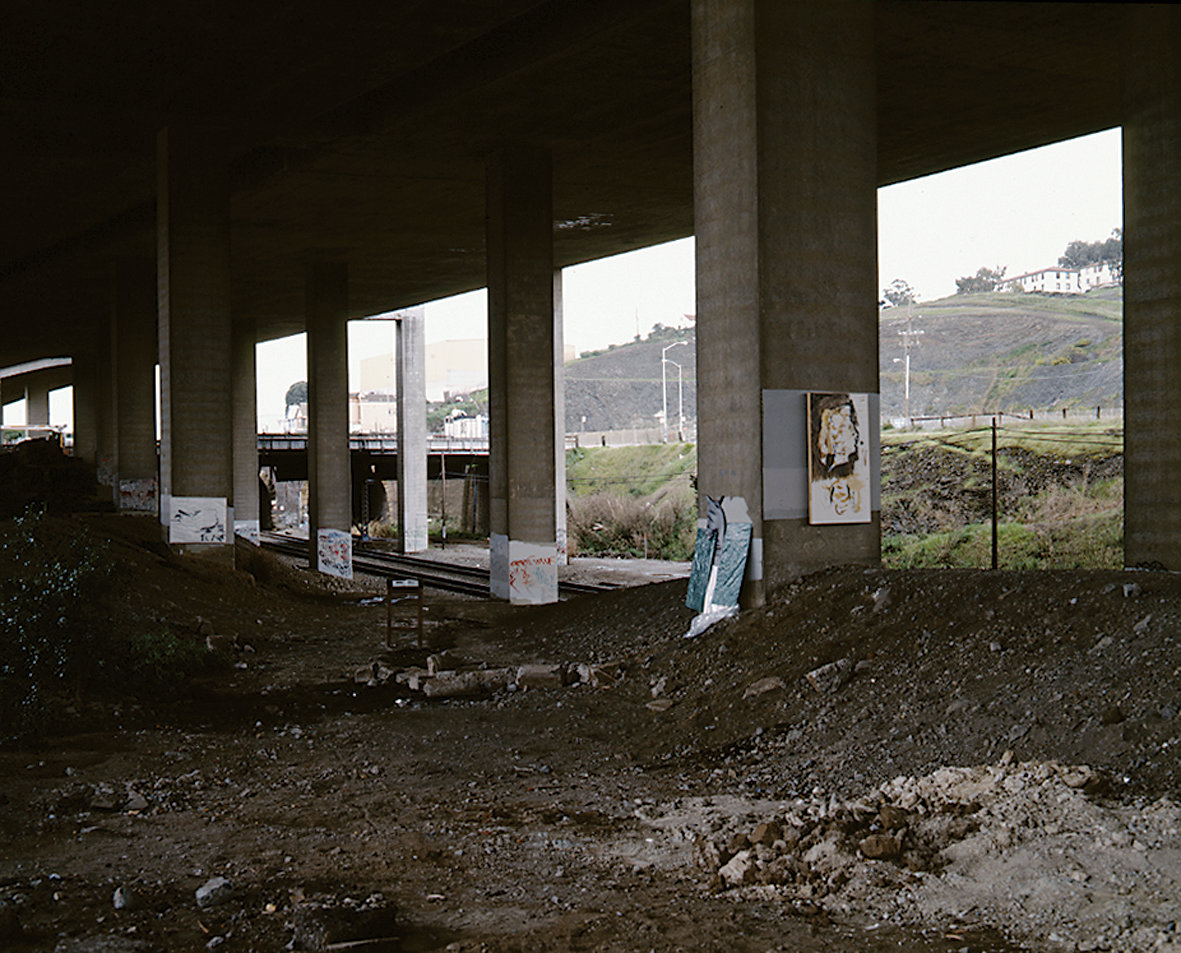
The Outdoor Exhibition Space Munich - San Francisco Questions & Answers
An Interview with Michael Clegg and Martin Guttmann for the exhibition at the K-Raum Daxer, Munich - The Outdoor Exhibition Space, Munich - San Francisco, May 1992
So what possessed you to transport a group show of Armaly, Bonin, Krebber and Mueller and reinstall it under a highway bridge outside San-Francisco?
Let's get the facts straight. The group shows you are referring to was one of the first shows at Kunstraum Daxer. It was an important event for all parties concerned and it was accompanied by a catalogue. It became an integral part of the identity of the space, part of the 'historical memory' so to speak. Therefore every subsequent show in Kunstraum Daxer is installed 'on top' of this group show. Our idea was that if we could look at the same group show installed in a very different location, it would become possible to evaluate how the context of Kunstraum Daxer influence the way we see art there, what is the 'systematic distortion' the Kunstraum Daxer exerts on the art shown there.
And then you will show photographs of the re-installed group show, in the Kunstraum Daxer?
Yes, that will close the circle. Assuming that the photographs convey the relevant information, the show will demonstrate a technique of self-reflection. It is a show which reintroduces its own context by examining the systematic 'distortion effect' of the context.
What about taking your Photographs and installing them somewhere else?
The show intends to introduce a process of self-reflection which should continue after the show is over.
But isn't this process a way of looking at art as means and not as an end?
Every process of analysis involves a certain amount of objectification. so when you analyze yourself you become the object, at least temporarily. We conceive of the project as a collaboration with all the artists involved, because of that we see it as a collective self-analysis of a group of artists who are involved with each other professionally and personally. In that sense we are all the beneficiaries of the project.
What kind of insight do you expect to gain with such a project?
There are various aspects to the work which cannot be all summed-up schematically, but one thing seems clear - seeing the work installed outside, makes a tremendous difference.
In that sense this project is connected to the three bookshelves or libraries as you call them which you installed in outdoor locations in the outskirts of Graz.
Absolutely, in both cases the outdoor location intends to have a liberating effect.
In conjunction with the placement of the bookshelves, there was an installation in the Grazer Kunstverein. On the bookshelves there was a plague with the address and phone-number of the Kunstverein. People were directed to the installation in order to gain information about the project
In other words, the museum installation had a 'use-value'.
That aspect of the project was very important for us. We imagined two possible scenarios. In the first a person who sees the outdoor library comes to the museum and every things she sees there is subordinated to interest in the outdoor libraries, or more generally, the interest in utopian thinking about institutions. The second scenario concerns a person who first sees the museum installation and then sees the outdoor libraries. For him, the outdoor libraries become ready-mades, functional objects which are incorporated into the art context.
Can you elaborate more on the Duchampian aspect of the project?
There are many different interpretations of the ready-mades which generalize different aspect of Duchump's thinking. For us, though the central point of the ready-mades was of alienating objects at its function. Looking at something that was made for a particular person, as if its purpose was not an integral aspect of it.**
Could you say - liberating an object from its purpose?
Well, partially. On one hand, there is the point about the liberative effect of de-familiarization. as the surrealists would say. In that sense the whole project of the ready-made can be seen in surrealist terms. On the other hand, the ready-made is an alienated object which receives 'too much attention', and is 'uncomfortable with this attention'.**
How do these categories apply to the libraries and to the outdoor exhibition space?
On the one hand both projects are located in the surrealist / situationist tradition. The idea is to make art that may liberate our imagination that gives a concrete and realistic form to the idea that the world could be different and better. On the other hand art works are born into a world which will necessarily alienate them, shown in contexts that will necessarily distort the original intentions of their producers. In such a world the idea of anticipating the effect of the context is a form of self-defense guided by a desire for autonomy.**
Let's go back to your point about 'use-value'.
The libraries in Graz were intended to be used as lending libraries. But more importantly we wanted to use the Graz project as means for collecting very vital data on the local community. We asked a question: What happens when you leave books unprotected by guards or librarians? How will people react to such a utopian proposition? People are very opinionated about questions like that, But they have no data to rely on. we wanted to check there preconceived ideas. We saw it as a way of providing a portrait of the community.**
Do you take the term portrait seriously? Do you see a connection between these projects and the corporate portraits you made in the 80's?
Very much so. One of the most important aspects of portraiture is that portraits answer a demand for representation which exist independently of any particular art institution. The demand of portraits executed later (?) then such museums or commercial galleries. In that sense, portraits have a use-value. People use portraits to construct their identity**
Is that use-value limited to portraits?
Of course every work of art or consumer object is made to construct the identity of its owner, but portraits make this point sharper and clearer.**
So how do you see the connection between the portraits and the outdoor projects?
When you make objects which have a use-value, you operate outside the art world or at least in the margins of the art world. We operate like 'commercial' artists when we are doing portraits, and 'social engineers' in the case of the outdoor libraries. But in both cases the point is to stretch the concept of art by pointing to its arbitrary borders.**
Do I detect an allusion to 'Art after Philosophy'?
Yes, the idea of art whose content is the attempt to re-define art is a very powerful and inspiring idea. Especially of the re-definition addresses questions about the art institutions.**
That brings us back to the issue of this show.
That's right - one of the questions we are asking is why do we need to see art indoors? or rather what is the systematic effect of that seeing art indoors has on the meaning of art?**
Are you seriously thinking about showing art outdoors?
Why not? outdoor locations like the spaces created under bridges virtually solve the problems of whether conditions. It is a rather profound fact that the main reason why we see art indoors is because people believe that art has to be protected against the violence of the discontent.**
What about 'public art'?
Public projects usually look at questions of a vandalism as if they are technical issues. They think that violence and alienation are part of nature like rain and snow and try to address them as part of the technical specifications. In that respect the success of a public art depends on its ability to anticipate and to suppress the anger and frustration of the local community. This is certainly not our intention. We would like to be able to reflect local frustration and alienation as part of our preoccupation with the context. We are getting nearer and nearer to a world where the rich live inside fortresses and the poor try to get in. These processes exist on many levels, as the west protects itself from the third world - "Fortress Europa" blocking itself from the east and south. Most European countries adept tighter immigration control policies in response to right-wing xenophobia, and within the cities, especially in the big American cities there are more and more guards, more private security forces protecting against the outsiders who try to push in. Artists have to redefine art and make it possible to conceive of it as something else but escapist entertainment for the analysis of these fortresses.**
That's a hefty job indeed.
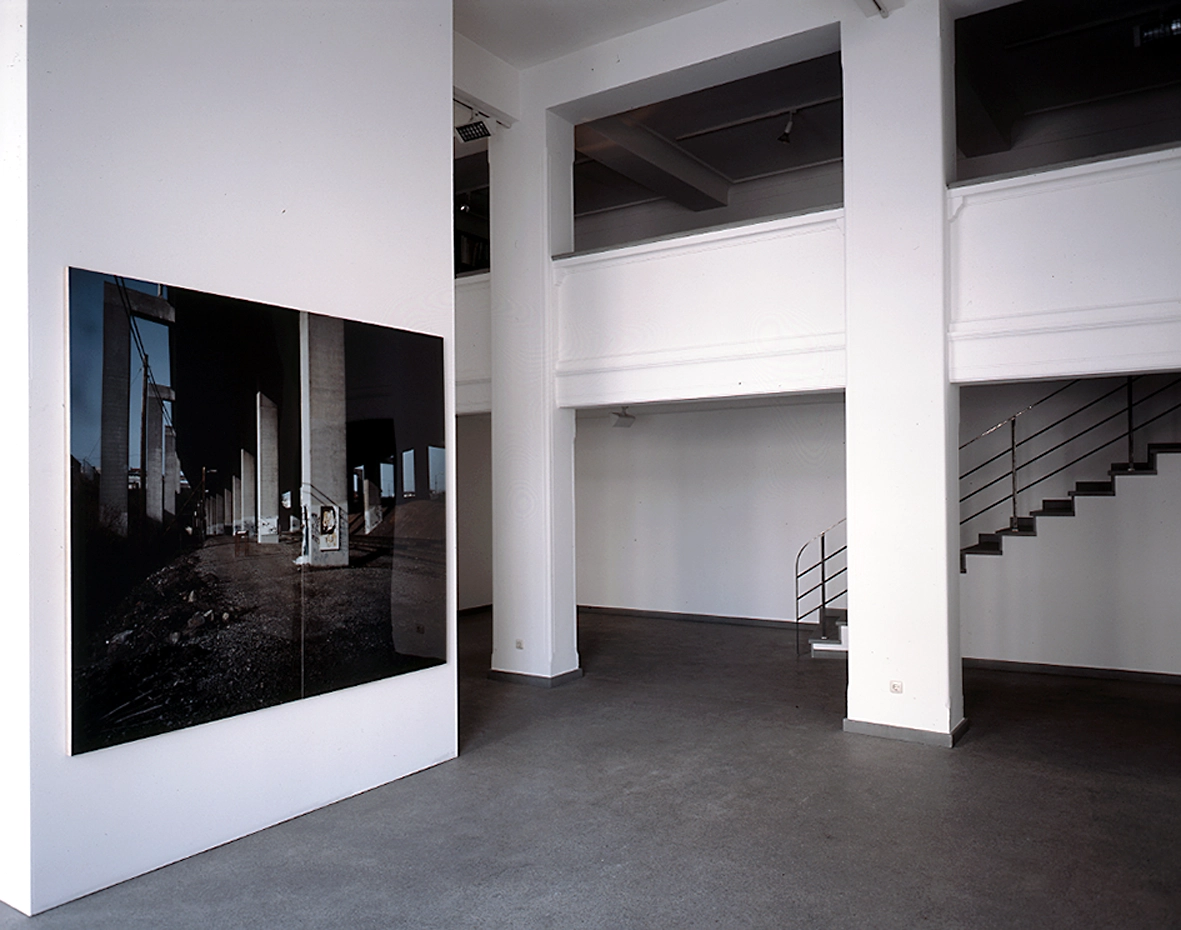
Installatiion at the K-Raum Daxer, Munich - 1992
The Outdoor Exhibition Space Munich - San Francisco
Essay for the exhibition at the K-Raum Daxer, Munich - The Outdoor Exhibition Space, Munich - San Francisco, May 1992
The Sick Soul IV - An Auditorium for Film, a Runway for Fashion and a Stage for Music Performance
Mamacita Fashion gallery, Mexico City 1997